#147 LITTLE LAMB, MIGHTY PEN
Please grab a drink and find a comfy chair. This is a long story. I considered splitting Sarah's story into two chapters, but I think the length here rather reflects the extraordinary depth of her contributions to American women in the 19th century. Often asked " Who would you invite to a dinner party?" Sarah would be one of my guests; she would be judgmental but her knowledge and ideas would be fun to hear. And I can just see her sizing up life in the 21st century, and not holding back with her observations.
SARAH JOSEPHA (BUELL) HALE

Most people know Sarah Josepha Hale for one small lamb. She was the author of “Mary Had a Little Lamb,” the nursery rhyme that has followed generations of children into schoolrooms, songbooks, and memory. But Sarah Hale was much more than the woman behind a famous verse. She was a widowed mother of five, a pioneering editor, a champion of women’s education, a campaigner for Thanksgiving, a supporter of women doctors, and one of the most influential American women of the nineteenth century. Her lamb may have been little, but Sarah Hale’s ambitions were anything but.

THE WOMAN BEHIND THE LAMB
Sarah was born Sarah Josepha Buell on October 24, 1788, in Newport, New Hampshire, one of four children of Gordon and Martha Whittlesey Buell. Her parents valued education at a time when girls were usually given limited schooling-- only enough to gracefully manage a household. Sarah’s family expected more. Sarah later credited her mother’s teaching and example with awakening her love of books and learning.
Although Sarah did not attend college, she received a remarkably serious education at home. Her older brother, Horatio, who attended Dartmouth, helped tutor her, and she studied far beyond the usual expectations for a girl: literature, languages, geography, philosophy, Latin, and the classics. As a teenager she read widely, including Shakespeare. This early education shaped her. Sarah grew up with a serious respect for books, self-discipline, and moral purpose. She was not raised to be frivolous. She was raised to think. At the same time, she was very much a woman of her age. She believed deeply in the importance of home, family, religion, duty, and proper conduct. Later in life, some of her attitudes would seem conservative, especially her belief that women’s greatest influence came through the home and through moral guidance rather than through politics. But beneath that conventional surface was a powerful conviction: women needed education because women mattered.
As a young woman, Sarah
became a schoolteacher, one of the few respectable occupations open to an
educated woman. In 1813, she married David
Hale, a New Hampshire lawyer. The marriage was described as intellectually
supportive: David encouraged her studies, and the couple reportedly spent
regular evening hours reading and studying together. They had five children. For
a time, Sarah’s future seemed secure: marriage, children, books, conversation,
and a place in a respectable New England community.

Her personality matched her appearance. Hale was orderly, energetic, deeply principled, and extraordinarily persistent. She had strong views on home, religion, motherhood, education, manners, and women’s responsibilities; she was not passive or timid. She could be conservative in theory and surprisingly bold in practice. Again and again, she took on causes that seemed sentimental — children, schools, widows, Thanksgiving, Mount Vernon, domestic labour — and turned them into organized public campaigns.
What made Sarah Hale especially interesting was her combination of gentility and force. She believed in propriety, neatness, duty, and feminine influence, yet she also ran one of the most powerful magazines in America, supported her family by her pen, advised major public men, promoted women’s education, and helped shape national traditions. She did not present herself as a rebel, but her life quietly challenged many of the limits placed on women in the nineteenth century.

After husband David’s death in 1822, Sarah first tried to support herself through a millinery business, but friends also helped publish her poems. The modest success of that poetry collection led her to write the novel, Northwood, and based on its success she was then offered the editorship of a new women’s magazine in Boston. She was forty years old.

Sarah Hale caught his attention as she had already proved herself as editor of The American Ladies’ Magazine in Boston. She had built that magazine around original writing, moral purpose, female contributors, and the improvement of women readers. In other words, she offered exactly what Godey’s magazine lacked: a clear editorial voice and a serious purpose.
Godey’s solution was bold. Rather than merely hiring Sarah, he bought The American Ladies’ Magazine in 1837 and merged it with his own publication. He then invited Sarah to become editor of the combined magazine, which became Godey’s Lady’s Book. This was not simply a business purchase; it was a strategic move to acquire Sarah’s reputation, her readership, and her editorial standards. Sarah described herself proudly as the “Editress” of Godey’s Lady’s Book, a title she preferred because it marked her authority and her womanhood in a profession still dominated by men. She held this position for 40 years.


Under Sarah’s editorship, the magazine also helped shape American moral and cultural values. Hale promoted women’s education, women writers, domestic responsibility, Thanksgiving, national unity, proper manners, household order, and respectable reform. She did not advocate "radical political equality", but she gave women a strong public voice through literature, education, charity, and moral influence. Under Sarah’s editorship, the magazine became a powerful guide to taste, manners, education, domestic life, and respectable reform. For many American women, Godey’s was part fashion magazine, part literary journal, part household manual, and part moral adviser.
A WOMAN OF MANY CAUSES
Having known widowhood, financial pressure, motherhood and the need to earn a living, Sarah understood that women needed education, legal protection, practical skills and social support. She did not limit herself to one cause or one corner of reform. She was an editor, author, reformer, educator, fundraiser, and national campaigner who used the pages of Godey’s Lady’s Book to promote causes she believed would improve women’s lives, family life, and American society.
HELPING WOMEN SURVIVE AND
WORK
Sarah was concerned that poor women, widows, working mothers needed respectable ways to make money.
The Seaman’s Aid Society (1833) Sarah’s work with the Seaman’s Aid Society grew out of her sympathy for women whose security depended on men who went to sea. Sailors’ widows could be left suddenly poor, with children to support and few respectable ways to earn money. Hale’s answer was not simply charity, but organized help that preserved dignity. The Society provided employment for seamen’s wives as seamstresses and gave them a place to sell their work. In time, it expanded into a broader institution, including a Mariners House, a boarding house for sailors, and services for their families. Her goal was practical: women needed work, income, and community support, not pity alone.


Trade Schools for Women (1830s, 1840s) Hale believed that education should prepare women for real life, including the possibility that they might have to support themselves. Her interest in trade schools for women reflected that belief. Through the Seaman’s Aid Society, an industrial school was developed for seamen’s daughters, giving girls useful training rather than leaving them dependent on uncertain charity. This was very much in keeping with Hale’s larger view: women might remain within the accepted “woman’s sphere,” but that sphere had to include skill, competence, and the ability to earn a living when necessary.
This belief fit perfectly with Sarah’s broader view of women’s work. She thought women had a special responsibility for the moral and intellectual development of children, but she also believed that this work deserved organization, seriousness, and public support. The infant school allowed mothers, especially working mothers, to combine protection, education, and was a practical support system; their children could be cared for while they earned money. The results were important. Sarah’s school helped provide care and instruction for her own son and for other young children, and it placed her among the early supporters of what became the kindergarten movement. Her children’s writings, including moral songs and poems, also reflected this interest in teaching the young through delight rather than stern instruction alone. In Sarah’s mind, kindergarten was not a luxury. It was a way to protect children, assist mothers, and build better citizens from the earliest years.

Work Among the Poor Hale’s work among the poor was shaped by her belief that poverty should be answered with opportunity, training, and moral encouragement. She did not see poor women merely as passive recipients of aid. She saw many of them as capable people trapped by widowhood, low wages, lack of training, or the demands of motherhood. Her reforms tried to give them the tools to help themselves: paid sewing work, schooling, child care, access to books, and safe lodging connected with maritime life. At the same time, her views were very much those of her century. She valued respectability, Christian duty, domestic order, and moral improvement.
Property Rights for Married Women (1850s) Hale’s views on married women’s property rights show the practical side of her feminism. She was not a radical advocate of political equality, and she did not make women’s suffrage her cause. But she did argue that married women needed legal protection over property and earnings. Her own experience as a widow helped her understand how vulnerable women could be when law and custom placed property in male hands. To Hale, protecting a woman’s property was not an attack on the family; it was a way to protect wives, mothers, and children from poverty and dependence.
Women’s political and economic rights Hale’s position on women’s rights was both progressive and conservative. She did not support women’s suffrage, because she believed voting belonged to the male public sphere; she believed, however, that the "secret, silent influence of women could sway male voters" and that a women’s influence should work morally through family, education, and social reform.
Sarah was more focused on women’s economic and legal rights. She supported married women’s property rights, better wages for women, and wider opportunities for women to earn a living. Her own widowhood had taught her how vulnerable women could be when law and custom left them dependent on men. She did not call for women to abandon the home; she argued that women needed education, property protection, and paid work in order to protect themselves and their families.
EDUCATING WOMEN AND CHILDREN
Higher education for
women Sarah Hale believed that women had a right to
serious education, not merely the “accomplishments” expected of fashionable
young ladies. She argued that women were the intellectual equals of men, but
had been denied equal opportunities to develop their minds. To her, women’s
education was not a threat to home life; it strengthened it. An educated woman
would be a better mother, teacher, moral guide, and citizen. Through Godey’s
Lady’s Book, she promoted women’s education, women teachers, women
professors, normal schools for teacher training, and colleges such as Vassar.
She wanted women to study real subjects — literature, science, languages,
mathematics, and useful knowledge — so that they could think, teach, earn, and
influence society responsibly.
Vassar College (1861) By offering women a serious liberal arts education comparable to that available to men, Vassar College in Poughkeepsie, New York, became a landmark in the struggle for women’s higher education. Sarah Hale was not the founder of Vasser, but she was one of its important champions because it represented one of her lifelong goals: serious education for women, not just polite accomplishments like music, drawing, and manners; it helped move women’s education from seminaries and finishing schools toward full college-level study in literature, science, languages, mathematics, and the arts.


More women teachers in primary schools Hale strongly advocated for the employment of women as teachers, especially for younger children. She argued that women were well suited to primary education because they were already recognized as caregivers and moral guides of children. But she did not think affection alone was enough. Women teachers needed proper training, so she supported normal schools — teacher-training schools — for women. She also made the practical argument that the growing nation needed many more teachers, and women could fill that need. By the 1850s, women had become a majority of American schoolteachers, a change that reflected the very cause Hale had promoted for decades.

PROTECTING WOMEN’S HEALTH
Women doctors and women’s medical education (late 1840s-1850s) Sarah supported the idea that women should be trained as physicians. This was controversial because medicine was still widely considered a male profession, and many people thought the study of anatomy and disease was unsuitable for “delicate” women. Hale disagreed. She believed women needed medical education because women and children often required care that female physicians could provide with greater sympathy, modesty, and moral safety. She supported Elizabeth Blackwell, the first woman to earn a medical degree in the USA.

By backing the Female Medical School of Pennsylvania, Sarah helped make such institutions seem respectable to middle-class readers. Her argument was not simply that women could be doctors, but that society needed them. By placing this issue before the large readership of Godey’s, she helped normalize the idea of formally trained women physicians. One of Hale’s strongest arguments was that women patients should have access to women doctors, especially for childbirth, reproductive health, and illnesses considered too intimate to discuss with men. Her reasoning was very much of her time: she believed men and women had different roles and qualities, but she used that belief to open a professional doorway for women. Female doctors, in her view, would protect women’s modesty while also improving medical care.
Hale also entered the debate over what female physicians should be called. She felt they should be called Doctresses. To her, a separate word made female physicians seem proper, feminine, and acceptable to the public. This shows both the progressive and conservative sides of Hale: she supported women in medicine but wanted that progress framed within respectable womanhood.
Women as medical missionaries (1840s-1850s) Hale also supported women entering medical mission work. She served as secretary of the Ladies’ Medical Missionary Society and urged that women be trained as doctors for work at home and overseas. This was a powerful argument because it connected women’s medical education with Christian service. Female physicians could reach women in other cultures who might not be allowed to receive care from male doctors.
Healthy dress Sarah treated women’s clothing as a health issue. She disliked the Victorian fashions of “wasp waist,” heavy skirts, hoops, and the fragile parlor-lady ideal. Although Godey’s was famous for fashion plates, she objected to tight bodices and restrictive dress because they harmed women’s bodies. This was a quietly radical position for the editor of a major fashion magazine: she was telling women that beauty and fashion should not come at the cost of health.

Women’s physical activity Sarah believed girls and women needed fresh air, movement, and exercise. As an antidote to the pale, over-dressed, over-delicate Victorian lady, she published lessons in calisthenics and recommended croquet, picnics, swimming, and especially horseback riding. She thought such activity would restore health and vitality better than medicine.

Male grooming Sarah was not afraid to criticize men’s fashion as well as women’s. During the Victorian enthusiasm for beards and whiskers, she campaigned against what she saw as a foolish and unattractive fad. She mocked heavily bearded men as “Whiskerandos” and objected that whiskers hid the face, blurred identity, and gave a man the look of someone concealing himself. Her objection was not only aesthetic; it was moral. To Hale, an open face suggested honesty, self-command, and respectability, while a face hidden behind hair seemed theatrical and untrustworthy. The beard debate shows her larger habit of mind: fashion, whether in houses, clothing, or faces, should never overpower cleanliness, simplicity, character, and common sense.
SHAPING THE AMERICAN HOME

The typical house and furniture Godey’s Lady’s Book helped shape middle-class ideas about the American home. The magazine offered readers pictures of model cottages, household plans, furniture designs, and domestic improvements. Sarah believed the home should be orderly, useful, moral, and tasteful, not merely fashionable and her own preference seems to have been for the sturdy, practical New England house and plain, serviceable country furnishings she had known in childhood. She was wary of the more elaborate Victorian taste that was beginning to appear—lace curtains, ornate furniture, decorative excess, and homes designed more for display than comfort. Still, as editor, she understood that readers wanted guidance on household style, so the magazine reported new fashions while often nudging women toward economy, usefulness, and good sense.
Fashion and class Hale understood that fashion was never just about beauty; it was also about class, aspiration, and social anxiety. She disliked wasteful fashion changes as it could waste money, time, and energy, especially for women who could least afford it. Yet she also knew that women cared deeply about looking fashionable, and that middle-class women wanted guidance on how to dress well without extravagance. Her solution was not to reject fashion completely, but to make it more economical, American, and practical and she saw that the sewing machine could save labour. Her argument was balanced: technology could help women, but only if it served health, thrift, dignity, and usefulness rather than vanity.
The sewing machine (1850s) Sarah Hale saw the sewing machine as a powerful ally for women because it could keep clothing production within the home. Instead of depending entirely on expensive dressmakers or European fashion authorities, women could make or adapt garments themselves. In Hale’s view, the machine could turn fashion from something dictated by elite dressmakers into something managed by capable women at home. The sewing machine helped blur class lines. A woman who could not afford a Paris dressmaker might still reproduce fashionable styles at home. Godey’s published patterns, fashion suggestions, and domestic advice and even offered an early kind of shopping service, buying and shipping clothing items for subscribers with an eye to economy and taste. This suggests that Hale recognized a new world of middle-class consumption: women were no longer merely sewing from necessity, but also using sewing, patterns, and mail-order convenience to participate in fashion.

The washing machine Hale was especially interested in the washing machine because laundry was among the hardest forms of household labour. She publicly called for inventors to produce a practical machine and rejoiced when, in 1854, Godey’s could show readers a mechanical washing device. Her reaction shows how seriously she took domestic work. Washing was not a minor inconvenience; it was exhausting physical labour, especially for women without servants. A working washing machine promised real relief.

The class meaning of
household machines For wealthier
women, machines might make the household more efficient. For poorer women, they
could mean something more urgent: fewer hours of backbreaking labour, more time
for children, and perhaps a little more dignity. Hale’s interest in washing
machines and sewing machines fits her broader reform pattern. She wanted women
educated and morally influential, but she also understood that women could not
be elevated if they were crushed by endless physical work.
Sarah did not treat fashion,
sewing, washing, and class as separate subjects. She saw that clothing
expressed status, that fashion could pressure women into waste, and that
machines could either liberate women’s time or feed new demands. Her ideal was
not luxury, but useful beauty: a home and wardrobe shaped by taste, economy,
health, and women’s own competence.
RESPONDING TO MODERN LIFE
Hale was watching the modern world speed up. She did not treat inventions as curiosities only; she asked what they meant for homes, women, education, taste, and moral life.
The railway Sarah seems
to have viewed the railway as one of the great signs of modern progress. “Twenty-one
miles an hour” captures the astonishment people felt when rail travel first
made speed a public experience. For Hale, modern transportation widened women’s
world. It made travel easier, spread magazines and books more quickly,
connected distant communities, and helped create a more national culture.

The camera Hale’s interest in the camera fits her broader respect for useful inventions. Photography made likenesses more democratic. Portraits were no longer only for the wealthy who could afford painted miniatures or oil portraits. A photograph could preserve family faces, record children, honour the dead, and create a visual memory of domestic life. She valued the camera not simply as technology, but as a tool of affection, family record-keeping, and historical preservation.

Gas lighting Gas lighting represented another form of modern convenience, but one with domestic consequences. A better-lit home changed reading, sewing, social life, and evening work. For a woman who valued education and improvement, more light meant more hours for books, music, conversation, and useful household activity. At the same time, gas lighting also changed taste: brighter interiors encouraged more decoration, stronger colours, wallpaper, pictures, and display. Hale’s response was practical but cautious. Light was progress, but it should serve comfort, refinement, and usefulness rather than empty show.

Artwork and visual culture Hale believed art belonged in ordinary homes, not only in galleries or wealthy houses. Through Godey’s Lady’s Book, women encountered engravings, fashion plates, architectural designs, illustrations, and lessons in taste. The magazine itself regularly included visual “embellishments,”; it published fashion plates, domestic architecture, sewing patterns, fiction, science, editorials, poetry, and youth activities. For Hale, art was not just decoration. It was a way to refine taste, educate the eye, encourage patriotism, and elevate family life.
Sarah Hale was neither blindly modern nor timidly old-fashioned. She welcomed inventions when they improved life, widened knowledge, strengthened the home, or made culture more available to ordinary people. The railway, camera, gaslight, and artwork all mattered because they changed how people moved, remembered, read, saw, and lived. Her question was always the same: could modern progress be guided toward moral improvement, education, beauty, and domestic happiness?
BUILDING NATIONAL MEMORY
Bunker Hill Monument (1840): The Bunker Hill Monument in Boston commemorates the 1775 Battle of Bunker Hill, an early and symbolic fight in the American Revolution that showed colonial forces could stand up to the British army. The Monument began as a grand patriotic project, but by the late 1830s it had stalled badly. Money had run out, work had stopped, and there was even talk of finishing it at a reduced height rather than completing the original 220-foot design. The Bunker Hill Monument Association had to sell off part of the battlefield land to raise funds, but even that was not enough.
Sarah Hale’s role with the Bunker Hill Monument was less “renovation” than rescue and completion. She succeeded because she understood something the male organizers had underestimated: women’s social networks could raise money quickly and publicly. Earlier fundraising by women and children had brought in only a modest sum, and some men objected to women donating household money at all. Sarah used her magazine platform to argue that women had both the right and the patriotic duty to contribute. She encouraged women to give small amounts—famously, a dollar—and made the monument a cause women could claim as their own. Her most effective strategy was the Ladies’ Fair. Instead of relying only on wealthy male donors, she and other women organized a large public fundraising fair at Quincy Market in Boston in September 1840. Through letters, newspaper notices, and women’s clubs, they asked women across New England and down the Atlantic coast to contribute handmade goods, art, needlework, household items, preserves, baked goods, and other saleable objects. This turned domestic skills—sewing, cooking, organizing, correspondence, hospitality—into public patriotic labour. The fair was a spectacular success. Thousands attended; the National Park Service notes that about 35,600 visitors came, a remarkable number for Boston at the time. The fair included dozens of tables and displays, with women’s groups from many Massachusetts communities taking part. In only a few days, it raised more than the goal that male fundraising had failed to reach for years.

The result was decisive. The money Sarah helped raise covered more than a third of the monument’s total cost, and it made it possible to finish the monument at its intended height. Other donations followed. Work resumed in May 1841, the capstone was laid in 1842, and the monument formally opened on June 17, 1843.
Sarah Hale saved the Bunker Hill Monument by turning women’s “private” domestic work into public patriotic power. She used her magazine, her reputation, and women’s networks to raise money where official committees had failed. In doing so, she showed that women did not need the vote or public office to shape national memory. They could organize, persuade, fundraise, and leave their mark in stone.

Mount Vernon (1853-1958) By the 1850s, George Washington’s beloved Mount Vernon estate had been reduced in size, the mansion was deteriorating, and there was a real danger that this powerful symbol of the young republic might be lost to neglect or private sale. Sarah did not personally start the campaign, but she used Godey’s Lady’s Book to give it national respectability. She saw Mount Vernon as more than an old house; it was a national shrine, a symbol that North and South might still honour together at a time when the country was coming apart. Her support helped show that women’s patriotism could take a practical form: organizing, fundraising, preserving, and shaping public memory.

Slavery Sarah opposed slavery, but her position was not the
same as the more radical abolitionists. She wrote that slavery was morally wrong
and damaging to both enslaved people and slaveholders; however, rather than
immediate abolition, she tended to
favour the education of enslaved people, their freedom, then encouragement of
African colonization. She disliked slavery, but she also feared disunion and as
editor of a magazine with both Northern and Southern readers, she was cautious..
Thanksgiving Day This was one of Sarah’s great lifelong causes. She saw
Thanksgiving as a way to strengthen national feeling during a period of growing
division and that it could be a shared national observance.
At the time, Thanksgiving was mainly a New England tradition, and different states chose different dates. Hale wanted one common day, especially the last Thursday in November, so that the whole country could pause together in gratitude. Her argument was domestic, religious, and patriotic. She believed Thanksgiving strengthened family life by gathering scattered relatives around one table. She also saw it as a Christian expression of gratitude for harvest, prosperity, and national blessings. But most importantly, she believed a shared Thanksgiving could help bind Americans together. Hale did not merely write sentimental pieces about turkey and pumpkin pie (but the magazine did offer such recipes as “Indian pudding with frumenty sauce”, “ham soaked in cider three weeks, stuffed with sweet potatoes and baked in maple syrup”).
For almost twenty years, she organized a serious pressure campaign, wrote editorials year after year, lobbied state governors, sent her arguments to public officials, ministers abroad, missionaries, and naval commanders, and kept asking for uniform observance. Her final and most successful appeal came during the Civil War. On September 28, 1863, she wrote directly to President Lincoln, asking him to make Thanksgiving a “National and fixed Union Festival.” She argued that only presidential action could give the holiday national recognition quickly enough. Five days later, on October 3, 1863, Lincoln issued a proclamation calling for the last Thursday of November to be observed as a day of Thanksgiving and Praise. Sarah suggested this date because it was the end of the farm season, elections were over, and summer wanderers had returned home.


Sarah also caused the “succulent
turkey" to be selected as the main feature of the Thanksgiving dinner.
Hale’s success lay in persistence: she turned a regional New England custom into a national ritual of family, gratitude, and unity.

CREATING AMERICAN LITERARY CULTURE
Through her magazines, Sarah Hale helped bring American readers to the work of writers such as Edgar Allan Poe, Nathaniel Hawthorne, Henry Wadsworth Longfellow, Ralph Waldo Emerson, Oliver Wendall Holmes, William Bryant. In particular, she published or promoted women such as Harriet Beecher Stowe, Lydia Maria Child, Lydia Sigourney, Catharine Sedgwick, the Cary sisters, Susan B, Anthony, Lucretia Mott. In doing so, she used a women’s magazine not only to discuss fashion and domestic life, but to build a national literary culture.


Her poems were widely
admired in her own day, though most have not lasted. What survived best were
her simple children’s poems, especially “Mary’s Lamb,” “Birds,” “Prayer”.
“Birds” teaches kindness to animals by asking a child not to steal young birds
from their nest, because doing so would grieve the mother bird. “Prayer” is a
simple child’s version of the Lord’s Prayer, meant to be easily memorized. “My
Mother’s Sweet Kiss” praises study, obedience, and a mother’s approval
rather than sweets or rewards. “The Thunder Storm” teaches courage and
trust during frightening weather. “The
Boy, the Bee, and the Butterfly” contrasts the idle butterfly with the
industrious bee, teaching children that work and preparation bring security
later in life.

FINAL YEARS
In her final years, Sarah Hale was still very much herself: disciplined, purposeful, charitable, and busy. When she could no longer go regularly to the offices of Godey’s Lady’s Book, she continued her editorial work from an upstairs room in her daughter’s Philadelphia home. "The room itself sounds like a portrait of her life: book-lined walls, a large desk stacked with papers and manuscripts, a shaded lamp, canaries, grandchildren nearby, and always more work to do."
Old age did not narrow her interests. She continued to support causes that had occupied her for decades, but she also took up newer reforms. She wrote about city parks and gardens, prison reform, public playgrounds, the abolition of child labour, women serving on school boards, and better educational opportunities for children. These concerns show that she remained forward-looking almost to the end. She had always believed that moral improvement needed practical institutions, and in her last years she still looked for ways to make American life healthier, kinder, and better educated.

Sarah's family remained central to her world.. Her sons were distinguished in military, scholarly, and legal careers; her daughters were educated at Emma Willard’s seminary, and her daughter Sarah Josepha became a teacher and ran a school for young ladies in Philadelphia. This was one of the quiet triumphs of Hale’s life: she had preached women’s education, but she had also practiced it in her own family.
Sarah earned substantial money over her long career as an editor and author, and she gave much of it away. Her charity was both public and personal. She supported large causes, but she also helped individuals, including people in literary circles who were struggling. This fits the image of a woman whose reform work was never merely theoretical; she believed help should be organized, practical, and personal.
Sarah and Louis Godey grew old together in their long publishing partnership. Godey retired from active publishing in August 1877, and Sarah laid down her pen that December, at age 89. She had been editor for over forty years. (That same year, Thomas Edison spoke the opening lines of Mary's Lamb as the first speech ever recorded on his newly-invented phonograph.)
Godey’s
Lady’s Book continued under other management, but it was never quite the
same. Her retirement marked the end of an era, because generations of American
women had grown up reading her advice, poems, editorials, fashion commentary,
moral lessons, and campaigns for reform.
Sarah, aged 90, died in Philadelphia on April 30, 1879. By then she had lived through almost the entire nineteenth century and had helped shape many of its domestic and reform ideals. Her final years show the same pattern as the rest of her life: work, family, faith, education, charity, and a belief that women could influence the nation from the editor’s desk, the classroom, the home, and the organized causes they chose to support.

Sarah Hale has not been honoured with the kind of grand national monument she helped secure for others, but her legacy is remembered in Newport, New Hampshire, through a memorial park with a bronze bust, historical markers, a Literary Landmark designation, and the annual Sarah Josepha Hale Award for Distinguished Literary Achievement. She is commemorated on the Boston Women's Heritage Trail. A world war 2 liberty ship was named after her.
SARAH JOSEPHA HALE PARK, NEWPORT, NEW HAMPSHIRE
Dedicated on November 23, 2013 at 3:00 p.m.
Located at the corner of North Main Street and Belknap Avenue on the Richards Free Library grounds, the Sarah Josepha Hale memorial park is a permanent historic monument, honoring the legacy of Newport native Sarah Josepha Buell Hale (1788-1879). It has been designed to be both educational and contemplative. It was dedicated on November 23, 2013 in celebration of the 150th anniversary of Thanksgiving. From this small New Hampshire town Sarah J. Hale grew to a position of influence felt across the nation. Through her editorship of the Boston Ladies Magazine and American Ladies Magazine and Godey’s Ladys Book (1828-1877) Mrs. Hale promoted the education of women and the importance of their role in society.
Components of the Park
The Park consists of three paths leading to a central circle with multiple aspects featured in the central area to commemorate the many facets of Hale’s life and her contributions to literature, history and culture. A lamp to illuminate the Park at night casts a silhouette of Sarah Josepha Hale and an image of the characters in her well-known poem Mary and Her Lamb.
- The central component is a bronze bust of Mrs. Hale atop a black granite pillar, symbolizing the black clothing worn during the fifty-seven years of her widowhood.
- An obelisk represents the Bunker Hill Monument which was erected to commemorate that significant battle of the American Revolution. The Bunker Hill Monument Association began the project in 1823 but it lagged until Hale became instrumental in its completion nineteen years later.
- A column of books bearing the titles of all of Hale’s works represents her contribution to American literature.
- Hale’s seventeen year campaign to have Thanksgiving declared a national holiday is commemorated by a pen and scroll and represents President Lincoln’s proclamation that Thanksgiving be celebrated yearly on the last Thursday in November.


“Warm up Sarah”
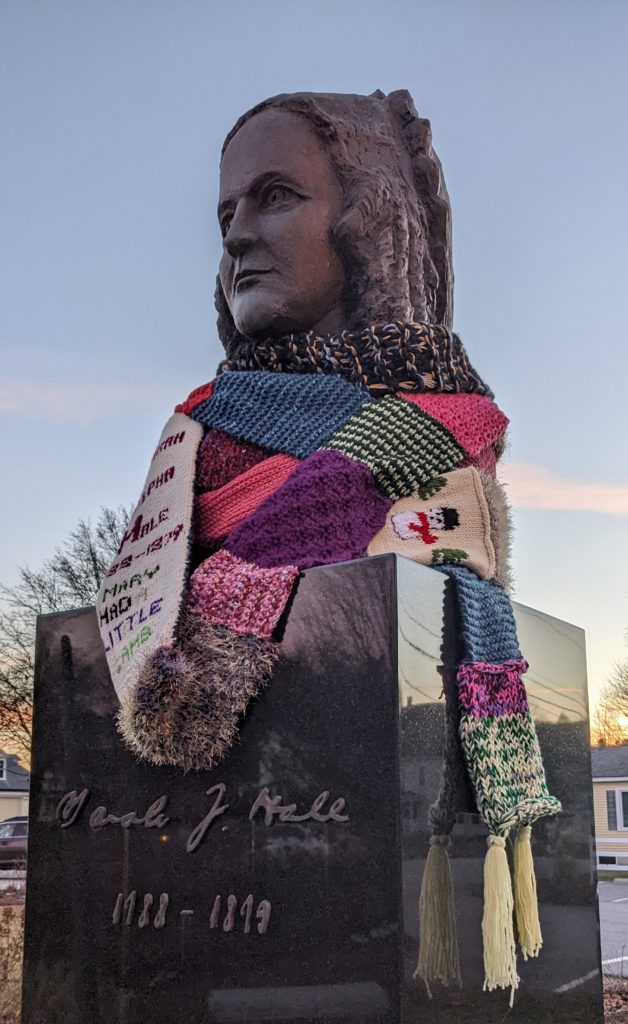
On October 24th, 2022 (Sarah’s 234th birthday), the library began the “Warm Up Sarah” project. Community members worked together to make a scarf for the SJH statue in front of the library. Fiber art pieces measuring 8 inches on one side were submitted in the weeks leading up to Thanksgiving. The scarf went around the SJH statue on Wednesday, the 22nd of November, with a sign explaining the project.
It was our hope that as a champion of practical handicrafts, Sarah Josepha Hale would approve of the scarf as a fun way to bring crafters together in our community. This project is an annual effort, so check the statue every Thanksgiving to see what Newport made for her.
T
THE SARAH JOSEPHA HALE AWARD FOR DISTINGUISHED LITERARY ACHIEVEMENT
Given by the Richards Free Library of Newport, New Hampshire, the Sarah Josepha Hale Award honors "a writer who, through his or her life work, maintains a connection to New England." Since 1956, a panel of twelve judges, including authors, educators, public figures and publishers have met to award the honor each year to a deserving author.
Originally, the award was conceived as a fundraiser of sorts. Poet and novelist Raymond Holden, who retired in Newport after serving as personnel director of the Book-of-the-Month, founded the Friends of the Richards Free Library to raise money for the institution. When bake sales and art festivals failed to generate enough funds, he hit upon the idea of bringing his old friend, Robert Frost, to speak. The public would definitely pay to hear Frost, and he figured that if he could convince Frost to come, other authors would follow suit. And knowing authors as he did, he knew money alone wouldn't lure them to a little New England mill town; he needed another hook to get their attention. A medal. A literary award. And so was born the Sarah Josepha Hale Award.
Because it is still a fundraising event, the award must be accepted in person. If the recipient cannot attend the ceremony, another winner is selected. To date, this has only occurred once. In 1963, President and Pulitzer Prize winner, John F. Kennedy was initially invited to accept it to mark the 100th anniversary of Lincoln's original proclamation of Thanksgiving, but his aides told the committee he was unable to attend due to a prior commitment. Fellow Pulitzer winner John Hershey was invited in his place and gave his acceptance speech on the same day that President Kennedy was assassinated in Dallas.
The award continues to grow in distinction and becomes more desirable in literary circles. John Hershey, when asked why he travelled so far to speak in a small New England town, replied that he "wanted the medal." Sarah Josepha Hale is honored each year by the award that bears her name, and the company of recipients becomes ever more distinguished with each addition.
Recipients of the award include Robert Frost (1956), Ogden Nash (1964), John Kenneth Galbraith (1967), Barbara Tuchman (1984), Doris Kearns Goodwin (1989), Arthur Miller (1990), Anita Shreve (2001), Ken Burns (2008), Judy Picoult (2019)

_steaming_out_of_San_Diego,_circa_in_March_1951_(NH_107205).jpg)
Key resource for this blog was Ruth Finley’s 1931 The Lady of Godey’s: Sarah Josepha Hale. (318 pages) It is a very readable, albeit quite sympathetic and admiring, account of Sarah the widow, editor, reformer, patriot and a woman of strong opinions. The book can be found on-line at https://archive.org/details/ladyofgodeys0000unse/page/16/mode/2up


Comments
Post a Comment